Can you have your own AI? What your company actually owns
Having your own AI: what is sold under that name to small businesses, who can really train a model, what your company owns in the end, and how to check.
31 min read

Sébastien Nobour
Founder of DEVEDANOS
You hear it in the media, you read it on LinkedIn: soon, AI will write all the code, and developers will no longer be needed. For a business leader thinking of having software developed, the question is a practical one. Should you wait? Is it still worth hiring professionals?
The promise is not new. Since the first computers, several major advances in computing have been presented as the ones that would make programmers unnecessary. As of today, in 2026, the available data show a profession that is changing, with fewer young people hired in occupations exposed to AI, but not a profession that is disappearing.
“Developer” actually covers several jobs. The coder receives a ready-made description of what to build, and turns it into a program that works. The developer starts from a problem and designs the solution themselves. The software engineer, finally, treats every choice as a hypothesis to test: they try something, observe what users do, correct course, and keep the software in a state where it can still be changed safely.
Dave Farley is co-author, with Jez Humble, of Continuous Delivery, the reference book on continuous software delivery, and author of Modern Software Engineering. He draws the same distinction between these three profiles in a video published in June 2025. For him, the software engineer approaches problems in a scientific, rational way, and knows, after each small change, whether their software can be released to production.
AI does not threaten these three jobs in the same way. For the first, the history of computing already offers a precedent.
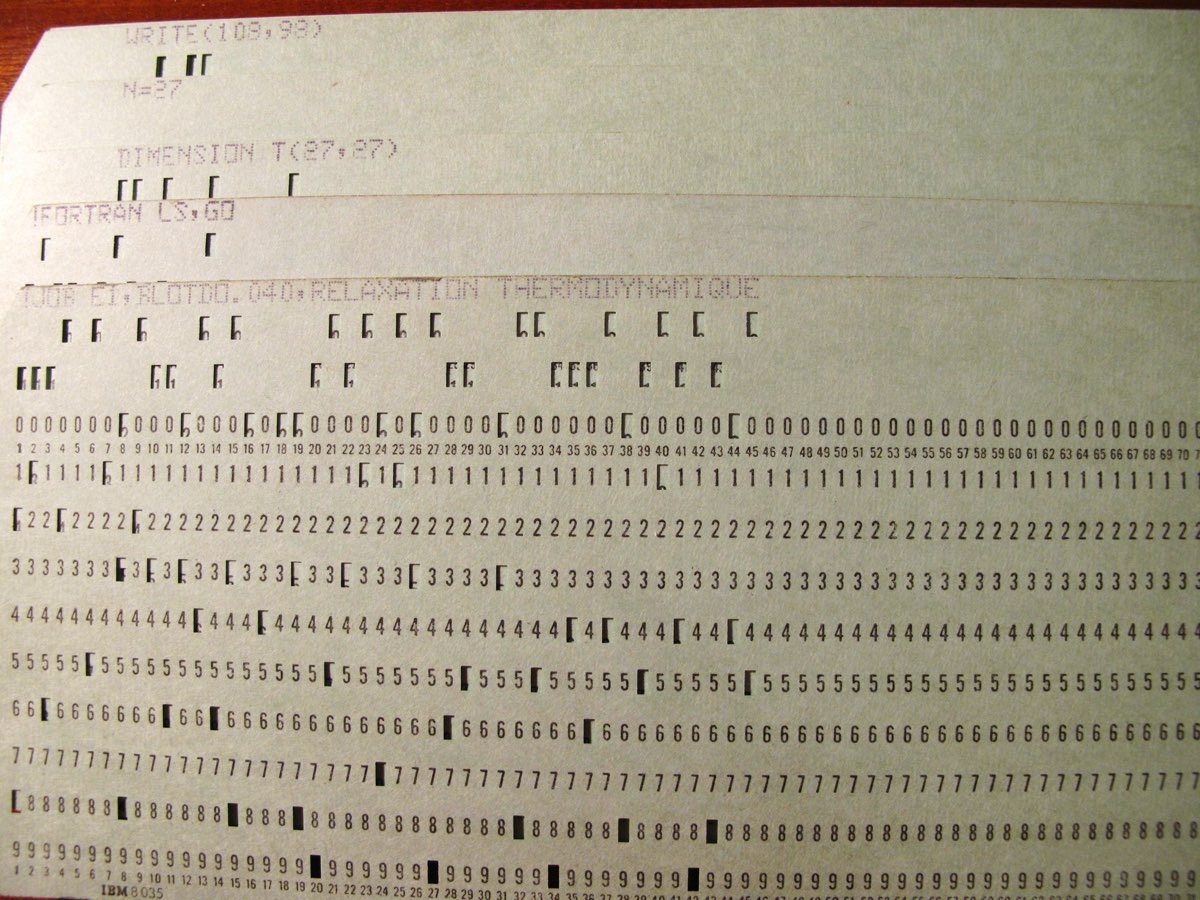
In the 1960s, a program was first written by hand, on coding sheets. It then had to be transferred onto punched cards so that the computer could read it. In large organisations, this work often fell to keypunch operators, who punched the cards on a keyboard, according to ACONIT, an association devoted to the history of computing, and the Fédération des équipes Bull, an association of former Bull staff. They mainly keyed in business data. In smaller organisations, programmers often punched their own cards.
The job was then most often given to women. The Fédération des équipes Bull document uses the feminine form, “female keypunch operator” (“opératrice de saisie”, in French), and asks for “dexterity” (“dextérité”, in French). Its only career path leads to “female verification operator” (“opératrice de vérification”, in French) or “female instructor” (“monitrice”, in French). The male job of “tabulating machine operator” (“opérateur de mécanographie”, in French), on the other hand, could lead to “commissioning technician (in fact a programmer)” (“technicien de mise en route (en fait programmeur)”, in French).
This division rested on a received idea that history has disproved: that women’s work was mere execution, carrying out what others had decided. In the United States, the first people to program the ENIAC, one of the very first computers, were women. According to the historian Nathan Ensmenger, quoted by Stanford University, their managers had chosen them because they saw programming as a low-skilled clerical task, “akin to filing, typing, or telephone switching”. Programming turned out to be demanding intellectual work. Men then moved into it, helped by recruitment tests based on personality profiles that favoured them. In France, the researchers Isabelle Collet and Nicole Mosconi reach the same conclusion in a 2010 article: women held 34% of computing jobs in 1982, and 20% in 2002. Men arrived in large numbers “as the jobs gained in prestige” (“à mesure que les emplois gagnaient en prestige”, in French).
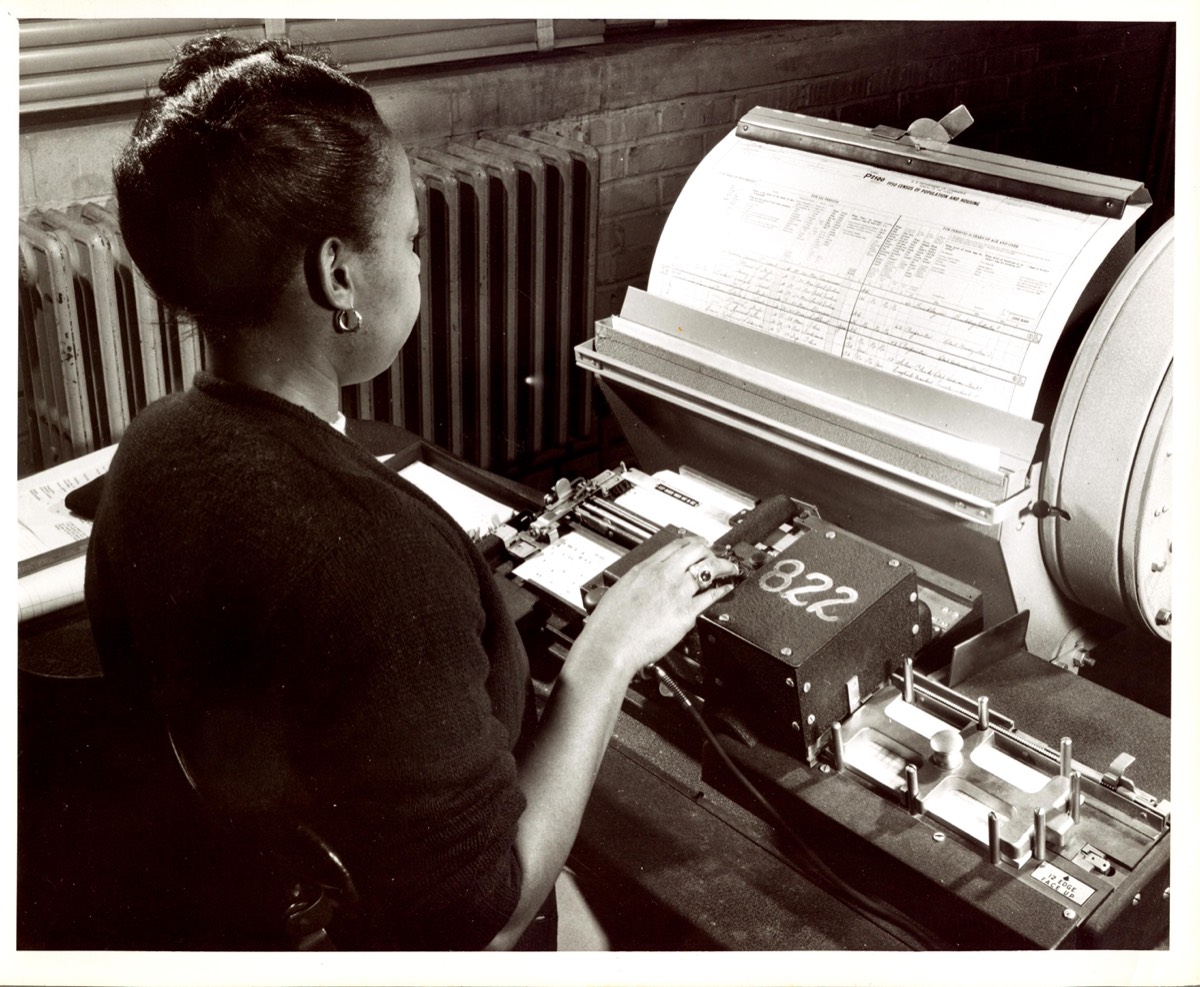
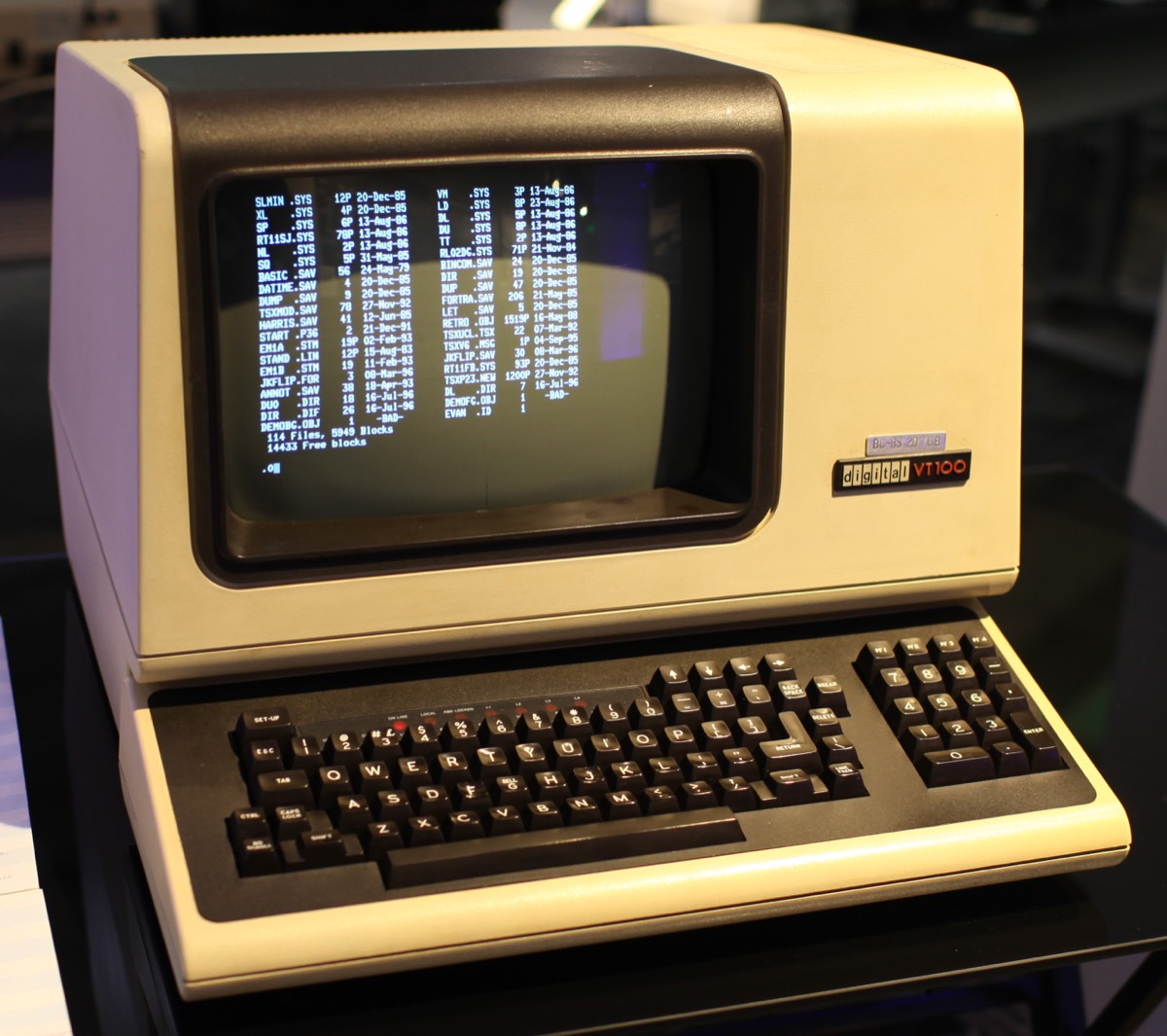
During the 1970s, terminals connected to time-sharing computers let programmers type in their programs themselves, without going through cards, according to Wikipedia. In 1980, in the United States, one in five people working in computing was still a keypunch operator. The Bureau of Labor Statistics, the US government agency for labour statistics, was already forecasting a fall in this demand. The job survived as on-screen data entry, which is still declining: 520,220 jobs in 1999, 174,930 in 2018, according to the Monthly Labor Review, the agency’s journal.
What has almost disappeared is not the programmer. It is the step where someone else typed in what a programmer had designed. In the United States, there were 176,500 programmers in 1970, according to a Bureau of Labor Statistics bulletin. In 2025, counting software developers alongside them, there are 1,828,600, ten times as many, according to the same agency. The 1970 and 2025 categories are not strictly comparable: this ratio gives an order of magnitude.
The Census Bureau, the US government census agency, describes programmers as professionals who work “from specifications drawn up by software developers or other individuals”. Among the job titles it places in this occupation is, in fact, that of “coder”. This is precisely the work AI tools already do well. In his video, Dave Farley considers AIs “very good at translating detailed instructions into code”.
The programmer occupation is already shrinking. According to the Bureau of Labor Statistics, there were 585,000 programmers in 2000 and 110,800 in 2025. Part of this fall comes from a change in classification: since 2000, US statistics have counted software engineers and developers separately. But for the next ten years, the Bureau still forecasts a 7% decline. It attributes this to the automation of part of the work, notably by AI, and to the fact that the most skilled tasks now go to developers.
As we read it, the coder now occupies a place comparable to that of keypunch operators: they carry out a description thought through by others. It is this step that AI tools are now taking on.
AI was not born with ChatGPT. The idea of a machine able to reason predates the first computers by several centuries.
At the end of the 13th century, the Majorcan philosopher Ramon Llull devised an “Art” based on combining notions. Some of his figures are made of circles that rotate on one another to form these combinations, according to the Stanford Encyclopedia of Philosophy, Stanford University’s encyclopedia of philosophy. In 1642, Blaise Pascal invented a calculating machine, now presented by the Musée des arts et métiers. In 1655, the English philosopher Thomas Hobbes wrote that reasoning amounts to calculating, as the researcher Giuseppe Longo recalls in a lecture at the École normale supérieure. Gottfried Wilhelm Leibniz, the German philosopher and mathematician, then dreamt of a language in which two people who disagreed would settle the matter by saying to each other “Let us calculate” (Calculemus, in Latin), reports The Public Domain Review.
In 1843, the British mathematician Ada Lovelace described the analytical engine conceived by Charles Babbage. She also set out its limit: the machine “has no pretensions whatever to originate anything. It can do whatever we know how to order it to perform”, according to her Note G.
In 1950, the British mathematician Alan Turing opened an article in the journal Mind with these words: “I propose to consider the question, ‘Can machines think?’”. In August 1955, John McCarthy and three other researchers proposed holding, the following summer at Dartmouth College, a two-month study devoted to “artificial intelligence”. Their proposal starts from the premise that every aspect of intelligence “can in principle be so precisely described that a machine can be made to simulate it”.
The AI tools people talk about in 2026 no longer just complete a line of code. They are agents. In a December 2024 publication, Anthropic, the company behind Claude, distinguishes two cases. In the first, a program runs through steps set in advance. In the second, which it calls an agent, the AI models “dynamically direct their own processes and tool usage”.
In development, an AI agent reads the existing code, changes it, runs the automated tests and starts again as long as they fail. Anthropic notes that an agent can “iterate on solutions using test results as feedback”. This is called agentic development. The same publication states that “human review remains crucial”.
As we read it, an AI agent is very good at a task that requires no judgement: turning a precise description into code that passes the tests. That is the coder’s work. It does not decide for you what deserves to be built, and it is not answerable to your users for that choice. So it is no longer enough to be a coder or a programmer: a professional’s value lies in what cannot be delegated to a machine.
This is not the first time a tool was supposed to make programmers unnecessary.
In November 1954, a team at IBM presented FORTRAN. This language lets you write a calculation in a form close to mathematical notation, then has the machine translate it into instructions. Its preliminary report promised that FORTRAN “should virtually eliminate coding and debugging”, debugging meaning finding and correcting errors. It was to make it possible to solve a problem for less than half the usual cost.
Thirty years later, Fred Brooks looked back on these promises. He had led the design of a major range of computers at IBM, founded the computer science department at the University of North Carolina, and received the Turing Award, the discipline’s highest honour. In “No Silver Bullet”, a 1986 essay, he pointed out that people had been talking about “automatic programming” for nearly forty years. He quoted another computer scientist, David Parnas: automatic programming “always has been a euphemism” for programming in a higher-level language than was previously available.
What was presented as a machine that programs on its own was in reality a new language, in which programmers still had to write.
In 1959, a committee convened at the initiative of the US Department of Defense designed COBOL, a language for business data processing. Its statements are built like English sentences, according to IEEE Spectrum. Jean Sammet, a member of that committee, wrote in 1978 that it was “certainly intended (and expected) that the language could be used by novice programmers and read by management”.
The idea came back in January 2023, when Andrej Karpathy, an artificial intelligence researcher and co-founder of OpenAI, posted this message:
The hottest new programming language is English
In February 1981, the British magazine Personal Computer World presented The Last One, a program generator. The journalist David Tebbutt saw it as software that could become “the last one ever written by a human being”. The coder is “going to have to change his job”, he wrote. Other computing professionals, in his view, would gain from it.
In 1982, James Martin published a book with an explicit title: Application Development Without Programmers. Having joined IBM at the end of the 1950s, he had become a consultant and written more than a hundred books on computing, according to The Register. In the preface, which the developer Simon Willison quotes on his blog, he predicted that “most computers in the future will have to work at least in part without programmers”. His book presents so-called “non-procedural” languages: you describe the result you want, not the steps to obtain it.
In the years that followed came CASE tools (computer-aided software engineering). They let you draw an application as diagrams, its data as well as its processing, and some then generate its code. IEF, designed by Texas Instruments with James Martin and his firm, produced COBOL code in this way, according to Wikipedia. In France, these tools accompanied the Merise method, developed from 1978 on the initiative of the Ministry of Industry: AMC Designor, MEGA or WinDesign, according to a course by Bernard Espinasse, a lecturer and researcher at Aix-Marseille University.
These tools were presented as the answer to the profession’s productivity and quality problems. In 1992, Chris Kemerer, then a researcher at the MIT Sloan School of Management, asked the question in the specialist journal IEEE Software: why do so many organisations buy these tools only to leave them on the shelf? He cited a study: one year after their introduction, 70% of these tools and techniques had never been used, 25% were used by only one team, and 5% were widely used, without their full potential being realised.
Object-oriented programming breaks a program down into “objects”, which group data together with the operations that apply to it. Brooks himself expected a great deal from it in 1986. He nonetheless doubted it would resolve the core of the difficulty.
In 1990, in the computing magazine BYTE, Brad Cox announced “a software industrial revolution based on reusable and interchangeable parts”, in “There Is a Silver Bullet”. Co-founder of the company Stepstone and the originator of the Objective-C language, he was selling “Software-ICs”: software components designed like the chips you assemble on a circuit board.
With content management systems (CMSs), building a website no longer requires writing code. WordPress, the most widespread, runs 39.7% of websites, according to W3Techs figures of 16 October 2026. Its plug-ins add a form, a shop or a calendar to a site: these are functions written by developers, which anyone can then install in a few clicks from the official WordPress directory.
The vendors of these tools promise to do away with code. In September 2010, Wix, a website builder, highlighted an interface where you build your site by dragging elements with the mouse, “removing complex computer codes from the equation”. These functions and tools are still written by developers. What changes is who assembles them.
In 2014, the research firm Forrester coined the term “low-code” for platforms that speed up application building by “dramatically reducing the amount of hand-coding required”. Low-code means building an application by assembling visual blocks rather than writing code.
In 2019, the research firm Gartner predicted that by 2024, low-code would account for “more than 65% of application development activity”, reports ADTmag. These platforms were meant to let employees with no programming training, whom ADTmag calls “citizen developers”, build their own business applications. In June 2021, Gartner went further: by 2024, 80% of technology products and services would be built by people who are not technology professionals, reports the website Technology Decisions. We have not found any review of these forecasts published by Gartner.
In February 2024, at the World Government Summit in Dubai, Jensen Huang, CEO of the chipmaker Nvidia, said, according to Tom’s Hardware: “It is our job to create computing technology such that nobody has to program.” And: “Everybody in the world is now a programmer.”
In January 2025, on the American host Joe Rogan’s interview show, Mark Zuckerberg, CEO of Meta, announced that Meta and the other companies in the sector would “probably in 2025” have an AI able to fill the role of a mid-level engineer, reports Fortune.
In February 2025, Sam Altman, CEO of OpenAI, the company behind ChatGPT, invited readers in a blog post to imagine an AI agent that could eventually do “most things” that a software engineer with a few years’ experience at a large company does, on tasks of up to a couple of days.
On 10 March 2025, Dario Amodei, CEO of Anthropic, spoke at the Council on Foreign Relations, an American foreign policy think tank. “I think we’ll be there in three to six months, where AI is writing 90% of the code,” he said. “And then in 12 months, we may be in a world where AI is writing essentially all of the code.” A week earlier, Anthropic had announced a $3.5 billion funding round.
These four statements come from the heads of companies that develop AI or make the chips it runs on. Two of them come with a deadline: 2025 for Mark Zuckerberg, September 2025 and March 2026 for Dario Amodei. They can therefore be compared with what has happened since. For the 90% announced by Dario Amodei, the only outside check we have found comes from Ryan Greenblatt, chief scientist at Redwood Research, an AI safety research organisation. In October 2025, he judged this prediction “probably false”. According to him, AI was then writing about 50% of Anthropic’s code, and 90% only in certain teams. For the deadline announced by Mark Zuckerberg, we have found no outside check.
None of these waves reduced the total number of people who develop software for a living, even though the number of programmers alone is falling. In the United States, programmers, software engineers and software developers held 1,282,000 jobs in 2000, and 1,828,600 in 2025, according to the Bureau of Labor Statistics. These figures count jobs: those who program for pleasure, or alongside another job, are not included.
In France, no public series tracks developers alone over a long period. The available figures cover all IT professionals: they show a trend, not the number of developers. There were 200,000 IT professionals in 1985 and nearly 300,000 ten years later, according to the Centre d’analyse stratégique and the Dares, the French labour ministry’s statistics department, cited by Le Monde Informatique. In 2017, Insee, the French national statistics institute, counted 730,000 people in digital occupations, an even broader group.
Chess offers a point of comparison. When machines became stronger than players, one might have feared that players would desert the game. In May 1997, Deep Blue, an IBM computer, became the first to beat a reigning world champion, Garry Kasparov, in a match played under tournament conditions, according to IBM. Players, for their part, have not disappeared. The French Chess Federation had 50,883 licensed players for the 2019-2020 season, and 92,815 for the 2025-2026 season, as of 1 September 2026: the number of licensed players has almost doubled, even though machines have played better than humans since 1997.
The same may be true of programming. Since February 2025, people have been talking about “vibe coding”, a term introduced by Andrej Karpathy: you describe what you want in everyday language, and the AI writes the code. According to the French-language Wikipedia, this practice lets amateurs with no software engineering training produce software. In our reading, many of these “vibe coders” are neither professionals nor developers by trade, and they do not appear in employment statistics.
For those who make it their profession, the 2026 market is tougher, especially early in a career. Apec, the French association for the employment of managers and professionals, counted 31,370 developer job ads on its site in 2022, and 15,830 in 2024. Only 24% of these ads were open to beginners, against 30% for all ads. The decline continued in 2025, with 12,690 ads, according to Le Monde Informatique. On the job site Indeed, software development ads published in France stood, as of 16 October 2026, at 51.3% of their February 2020 level, against 89.1% for all ads, according to Indeed Hiring Lab data.
In France, researchers at LIFT, a laboratory at HEC Paris, studied employers’ hiring declarations with the Banque de France. In their October 2026 study, permanent-contract hires of software developers and engineers aged 21 to 29 fell by about 42% between November 2022 and March 2026, against 11% in occupations less exposed to AI. The authors point out that this fall is also the hardest to attribute to AI: the sector had recruited heavily in 2021 and 2022, before interest rates rose.
Do those who announced the end of programmers forty years ago resemble those who announce it today? On one point at least: IBM in 1954, Brad Cox in 1990 and today’s AI company heads alike, the announcement came from those who created or sold the tool. The difference, this time, is real: an AI already writes part of the code. But the question remains the same. Who decides what that code must do?
Developers use AI. Every year, the question-and-answer site Stack Overflow surveys the developers who use it. In its 2025 survey, 84% of respondents use AI tools for development, or plan to. They are also wary of them: 46% doubt the accuracy of the answers, against 33% who trust them. Their main complaint, cited by 66% of them: solutions that are “almost right, but not quite”.
The Stack Overflow site, for its part, has lost most of its questions. For years, developers asked their questions there and found other people’s. In March 2014, 207,169 questions were posted. In November 2022, the month OpenAI launched ChatGPT, there were only 109,120, and in September 2026, 974. We took these figures on 20 October 2026 from the Stack Exchange public interface, which only counts questions still online. The decline had begun before ChatGPT; it sped up afterwards. As early as January 2025, Gergely Orosz, author of the newsletter The Pragmatic Engineer, noted that the site had not received so few questions per month since 2009, and saw in it the effect of AI assistants.
How much time AI saves developers remains hard to establish. METR, a research organisation that evaluates AI models, published in July 2025 an experiment carried out with 16 experienced developers who work on software whose code is public. For each of their 246 real tasks, a random draw decided whether or not they could use AI. With AI, they took 19% longer to finish their tasks. Before the experiment, they expected to save 24% of their time; afterwards, they still believed they had saved 20%. So they were going slower while believing they were going faster.
In February 2026, METR ran the experiment again with 57 developers and more than 800 tasks. This time the results lean towards a time saving, but METR considers them inconclusive, because of the way the sample came together. More and more developers declined to take part. Among those who did, 30 to 50% say they left out certain tasks because they did not want to do them without AI. The experiment therefore loses precisely the tasks where AI helps most: according to METR, the real gain is probably greater than the one measured. As of today, the organisation is revising its study protocol.
When writing code costs less, what was already slowing projects down becomes easier to see. Understanding the need, deciding what to build, gathering users’ reactions, connecting the software to the company’s other tools, checking that it works, releasing it: none of these steps goes faster because code is written faster.
Eliyahu Goldratt, a physicist turned specialist in industrial organisation, explains it in The Goal, a business novel published in 1984: speeding up a step that is not the bottleneck does not make the factory produce more.
The best software professionals have been saying so for a long time. As early as 1986, Fred Brooks distinguished two parts in building software. The first is translation: expressing an idea in the machine’s language, with its limits. The second is design: deciding the structure, often very complex, of what the software must do. In his view, the great productivity gains of the past removed obstacles in the first part: very limited machines, awkward languages, scarce computing time.
FORTRAN, COBOL, non-procedural languages, CASE tools, objects, CMSs, low-code: as we see it, each lightened the translation. None did away with the design.
“The hardest single part of building a software system is deciding precisely what to build,” writes Brooks. Clients, he goes on, have almost never thought their problem through in the detail software demands. Hence his advice: plan for many iterations between the client and the person designing the software.
In 2001, seventeen software practitioners signed the Agile Manifesto. One of its principles reads: “Business people and developers must work together daily throughout the project.” And it makes “working software” “the primary measure of progress”.
An AI that writes code also lightens the translation. It does not decide for you what your software must do. Allen Holub, author of books on software design, whom we quote in our article on building an app with AI, draws the same conclusion in a post: until an AI can hold a conversation with users to draw out their needs, this work remains human.
There is no such thing as "Agentic software development" or an "Agentic SDLC." There's just Agentic coding. Big difference. Coding is a small part of the overall process. […]
The coder deals neither with understanding the need nor with gathering users’ reactions: they receive a ready-made description. The developer takes some of this on, since they design the solution. The software engineer takes all of it on, because they work by experiment: each feature is a hypothesis, which use confirms or corrects. In his video, Dave Farley makes the point: understanding a problem well enough to write detailed instructions for it is still hard work.
We respect this distinction. What matters to us, in the end, is software engineering. The person who deals with engineering problems, and not just coding, will, in our view, be the last to be replaced, if that ever happens.
What should have been done from the very first projects is nothing new: work every day with users, release working software frequently, and check every change before it reaches them.
The useful question is not whether an AI will write your software’s code: it already writes part of it. The question is who decides what the software must do, who checks that it does it, and who will evolve it when your business changes.
When you hire a developer or choose a supplier, knowing how to write code is not enough. Ask them how they go about understanding what the software must do, and how they know, after each change, that it can be released to your users.
The 2025 DORA report, published by Google Cloud’s research programme on software development and delivery, draws on responses from nearly 5,000 technology professionals. It describes AI as an amplifier. It strengthens teams that already have good practices, and worsens the difficulties of the others. The difference lies around the code: automated tests that check every change before it reaches your users, a review of what the tool has written, releases that do not break what worked the day before.
Those who work this way did not wait for AI. It simply makes visible, to everyone, difficulties they have been pointing out for a long time.
At DEVEDANOS, AI is one of our tools, and it is these engineering practices that frame it. We talk with the users of your application to understand their needs and define the features. AI coding agents then write a large part of your software’s code. Every change they propose is checked by automated tests and reviewed before it goes into production. To steer these agents, we use our own Claude Code extension, agentic-cd (Claude Code is Anthropic’s development tool), as well as nWave, a public extension for the same tool. Our approach remains that of an engineering team: deciding with you what deserves to be built, and checking every change.
For custom software development, we work to a fixed budget, invoiced at the end of each month for the work done. Your application is usable within a month, with a few essential features: your users start working with it straight away, and how they use it determines which features come next. Once a feature has been signed off and released, it is judged on how your users respond, and we decide the next ones with you right away, for as long as you wish. A living application is never finished: once you stop evolving it, all it gets are security patches and updates to the components it runs on, and it is an application that is slowly dying.
So that what worked last month still works this month, we apply a zero-regression guarantee. If a regression is introduced, we fix it at no extra cost and add an automated test that checks the expected behaviour with every future change: the regression cannot come back the same way.
Can an AI agent build the application on its own? Our article on building an app with AI compares the different tools, and separates what they do on their own from what needs a professional. Are you preparing the budget for that application? Our article on budgeting an application explains why to aim for an objective rather than a list of features.
To hand repetitive tasks in your company over to AI, our AI automation for SMEs page describes what we can put in place.
Are you hesitating to launch your software while you wait to see what AI will do? Shall we talk?
Having your own AI: what is sold under that name to small businesses, who can really train a model, what your company owns in the end, and how to check.
Yes, AI can build an app that works. What the tool does well on its own, where it stops, and when to bring in a professional.
End of SaaS, SaaSpocalypse: since 2024, the claim keeps coming back. What it reveals about what you really pay for when you pay for software, and what we have known for more than forty years.